As global demand for green hydrogen accelerates, manufacturers and integrators are paying closer attention to one critical stack component: bipolar plates. In a PEM water electrolyzer, bipolar plates directly influence performance, efficiency, durability, and total cost of ownership—making them a key purchase decision for any hydrogen project.
If you are sourcing bipolar plates for electrolyzer applications, this guide will help you understand what matters most, what specifications to compare, and how a well-designed PEM bipolar plate can improve stack reliability and output. We’ll also introduce a practical option engineered for demanding operating conditions: TensorTechs PEM Water Electrolyser Bipolar Plate (also suitable for fuel cell stack requirements in many designs).
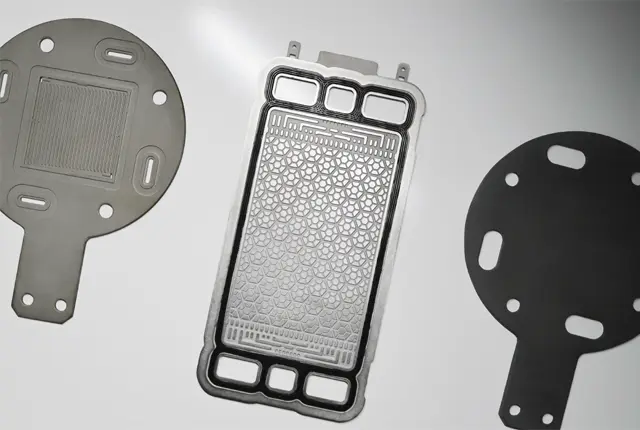
A bipolar plate electrolyzer stack needs to handle multiple functions simultaneously:
Conduct electrical current between cells with minimal resistive loss
Distribute water and gases evenly through optimized flow fields
Separate anode/cathode environments to prevent cross-mixing
Survive harsh electrochemical conditions (acidity, oxidation, pressure, temperature cycling)
Maintain uniform compression, sealing stability, and mechanical integrity
Because bipolar plates are repeated across the stack (often dozens to hundreds per system), even small improvements in conductivity, corrosion resistance, or flow distribution can yield major gains in stack-level efficiency and lifetime.
When evaluating a supplier for bipolar plates electrolyzer projects, focus on these engineering and production factors:
Material & Corrosion Resistance
PEM electrolyzers operate in a highly oxidative environment. Corrosion can raise contact resistance, contaminate catalysts, and reduce life. Look for materials and coatings designed for electrochemical stability.
Contact Resistance & Conductivity
Lower interfacial contact resistance means less voltage loss and better energy efficiency. This also reduces heat generation at high current densities.
Flow Field Design & Uniformity
Good flow fields improve water distribution and bubble removal (O₂/H₂), helping stabilize voltage and avoid local dry-out or flooding.
Manufacturing Precision & Repeatability
Stack assembly requires tight tolerances. Plate flatness, channel depth, and gasket interfaces affect sealing and long-term performance.
Scalability & Supply Reliability
For commercial electrolyzer deployment, you need consistent batches, scalable capacity, and controlled QC processes.
The TensorTechs PEM Water Electrolyser Bipolar Plate is designed for high-performance stacks where corrosion resistance, conductivity, and precision flow-field machining are essential. It is well-suited for system developers seeking reliable bipolar plates for prototyping, pilot-scale stacks, and commercial deployments.
This bipolar plate solution supports electrochemical applications where stable long-term operation, sealing integrity, and efficient current transfer are critical.
Below is a decision table you can use during sourcing to evaluate plate options for a bipolar electrolyser plate:
| Evaluation Factor | Why It Matters in a PEM Electrolyzer | What to Ask a Supplier |
|---|---|---|
| Base material | Determines corrosion tolerance and mechanical strength | What metal/substrate is used? Any datasheet? |
| Coating / surface treatment | Impacts corrosion resistance and contact resistance | What coating type? Thickness? Adhesion method? |
| Contact resistance | Directly affects stack efficiency and heat | Do you have measured ICR data under compression? |
| Flow field design | Controls water feed, gas removal, pressure drop | What channel pattern options are available? Can it be customized? |
| Flatness & thickness tolerance | Affects sealing, compression uniformity, leakage risk | What are your machining/stamping tolerances? |
| Operating conditions | Ensures plate survives real-world current density and pressure | What temp/pressure/current density are supported? |
| QC and traceability | Avoids batch inconsistency and early failure | What QC checks? Any lot traceability system? |
| Customization capability | Helps match your stack’s geometry and manifolds | Can you adjust port positions, channels, thickness, coating? |
A well-engineered bipolar plate can help you achieve:
Lower stack voltage through reduced contact resistance
Improved hydrogen production stability via uniform reactant distribution
Longer service life by resisting corrosion and surface degradation
Reduced downtime and maintenance thanks to reliable sealing interfaces
More predictable scale-up from prototype to production
In short, the bipolar plate is not a commodity part—especially in PEM electrolyzers where operating environments are unforgiving.
1) What are bipolar plates in an electrolyzer?
Bipolar plates are stack components that conduct current, separate cells, and distribute water/gases through flow fields. In a PEM electrolyzer, they must also resist corrosion in an oxidative, acidic environment.
2) How is a bipolar plate for a PEM electrolyzer different from a fuel cell bipolar plate?
They share similar structural roles, but PEM electrolyzer plates may face different electrochemical potentials and corrosion drivers. Material choice and coating strategy can differ depending on whether the plate is used on the oxygen-evolving side, hydrogen side, or both.
3) What is the most important parameter to optimize first?
For many PEM stacks, start with corrosion resistance + low contact resistance, then validate flow field performance and sealing. A plate that corrodes will quickly lose performance even if the initial conductivity is high.
4) Can bipolar plates be customized for my electrolyzer stack design?
In many cases yes—customization may include channel patterns, thickness, manifolds/ports, surface treatments, and dimensional tolerances. Confirm with the supplier what engineering support and minimum order quantities apply.
5) What causes bipolar plate failure in electrolyzers?
Common causes include corrosion, coating delamination, rising contact resistance, uneven compression, sealing groove mismatch, and flow field blockage or poor water distribution.
6) How do I qualify a bipolar plate supplier?
Request ICR data, corrosion test references, dimensional inspection reports, QC process documentation, and consider ordering a pilot batch for stack validation before scaling volume.
 English